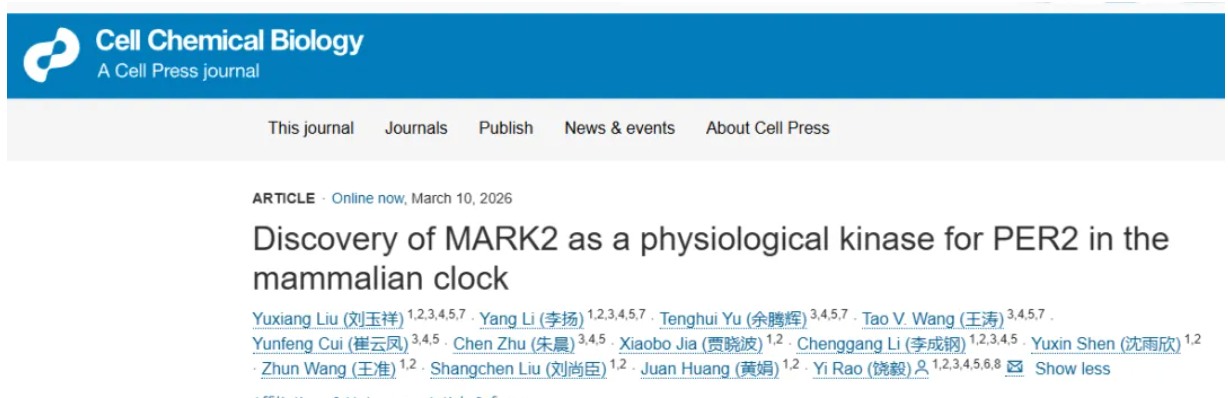
Cell Chemical Biology | Discovery of MARK2 as a physiological kinase for PER2 in the mammalian clock | Yi Rao Lab
Significance
The circadian clock regulates daily rhythms in physiology and behavior, and its disruption is associated with sleep disorders and other health problems. PERIOD2 (PER2) is a core molecular regulator of the circadian clock and a human mutation was discovered in 2001 in the PER2 gene changing the serine 662 to glycine (S662G) residue in PER2 protein causes familial advanced sleep phase (FASP) syndrome with phase advancement and period shortening. This mutation abolishes the phosphorylation of S662, a modification that acts as a molecular switch to stabilize PER2 and prolong circadian period. There has been much interests in identifying kinases phosphorylating S662 over the past quarter century. Here, after biochemical purification, we identified microtubule affinity-regulating kinase 2 (MARK2), an AMPK-related kinase (ARK), as a PER2 S662 kinase. Further examination of all 21 ARKs detected that some of them phosphorylated PER2 S662. MARK2 directly phosphorylates PER2, binds to PER2 and delays its degradation through S662 phosphorylation. Genetic deletion of MARK2 gene from cultured human cells led to shortened circadian rhythm, and this phenotype was dependent on PER2 S662. Specific deletion of the MARK2 gene from neurons in the mouse brain caused phase advancement and period shortening. Our work not only identifies MARK2 as a physiologically significant regulator of the circadian clock, but also highlights the effectiveness of biochemical approaches in solving physiological puzzles, and suggests possible involvement of ARKs in the clock by regulating phosphorylation of PER2 and other proteins.
DOI: https://www.cell.com/cell-chemical-biology/abstract/S2451-9456(26)00062-0