
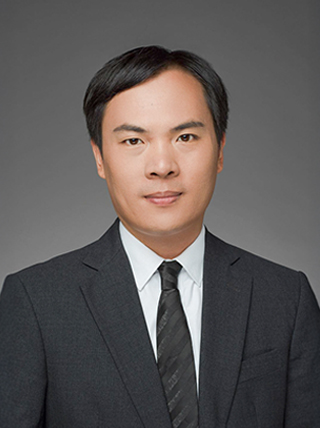
Yuchao Yang
2006–2010 Ph.D., Tsinghua University
2002–2006 Bachelor's degree, University of Science and Technology Beijing
2022 - present Professor with tenure, Ph.D. supervisor, Peking University
2019 - present Director, Research Center for Brain-inspired Chips, Institute for Artificial Intelligence, Peking University
2021 - 2022 Associate professor with tenure, Ph.D. supervisor, Peking University
2015 - 2021 Assistant professor, Ph.D. supervisor, Peking University
2013 - 2015 Senior researcher, University of Michigan, Ann Arbor
2010 - 2013 Postdoc, University of Michigan, Ann Arbor
Neuromorphic Devices and Brain-Inspired Computing
Based on metal oxides, a material system rich in complex ionic dynamics, thermal and electrical effects and coupling effects, our group has developed a variety of artificial neuromorphic devices, which can efficiently complete various bionic tasks and brain-like computing. Through careful design of the proportions of various components in the resistive materials and the geometry of the device, we can realize a variety of complex biological nervous system behaviors in small-scale nanodevices. The devices that have been designed, manufactured and functionally verified include: NbOx neurons with behaviors such as leakage, accumulation and firing; ZnO-EMIM artificial dendritic devices with long- and short-term plasticity at the same time; YSZ-based astrocyte devices; ultra-low-power artificial devices with power consumption of only 30fJ/spike synaptic device. Based on these novel neuromorphic devices, our group has further realized complex biological neural functions including time series analysis, associative memory and so on. Research results related to this direction have been published many times in top journals in the field, such as Nature Electronics, Nature Communications, Advanced Materials, etc.
Memristor-Based Efficient Computing System
In view of the diversity of computing methods in artificial intelligence algorithms, our group combines the internal dynamic characteristics of memristors with the advantages of memristor arrays in in-memory computing, and efficiently implements a variety of expensive operations in traditional computing platforms, including random number generation, matrix-vector multiplication, matrix attenuation and so on. As a result, we have achieved extremely low power consumption in many different types of artificial intelligence hardware computing systems. The current representative systems mainly include: the reservoir computing system based on the short-term plasticity of the two-dimensional ferroelectric material α-In2Se3, which can efficiently process complex timing information with extremely low power consumption; the phase-change memory(PCM)-based eligibility trace calculation system, which can efficiently implement the eligibility trace mechanism by using the attenuation caused by PCM conductance drift and can effectively accelerate the training process of reinforcement learning; the optimization problem solving system based on long-term plasticity TaOx memristor, etc. The research results in this direction have been published many times in top journals and conferences in the field of microelectronics such as Science Advances, Advanced Materials, IEDM, etc.
Design and Manufacture of Memristor Chips for Artificial Intelligence
For high-efficiency neural network processing hardware, our group has studied high-performance resistive memory integration technology for in-memory computing, multi-value storage devices, efficient read-write and computing circuits, and system-level chip architecture, focusing on device performance optimization and Key issues in in-memory computing architecture, such as advanced process integration, analog-digital interface circuit design, and software-hardware co-design.
Design and Fabrication of Memristor-Based Compute-in-Memory Chips for Artificial Intelligence
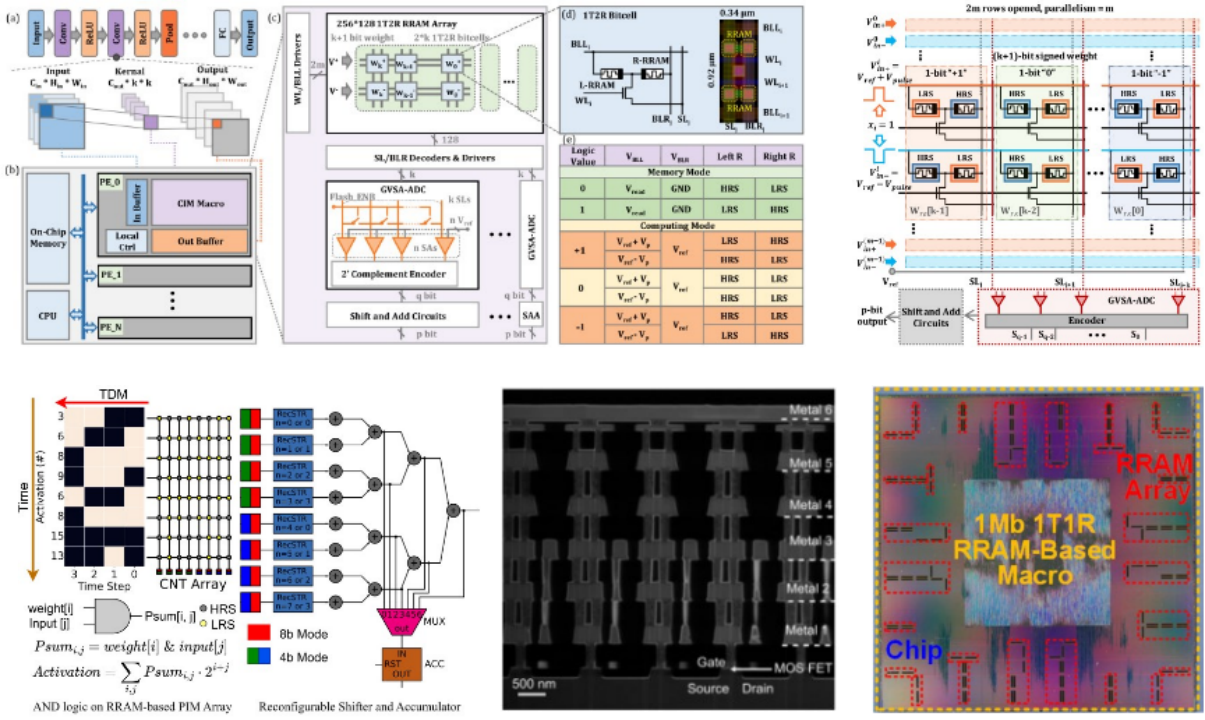
With the rapid development of artificial intelligence, the number of parameters and computation of advanced algorithmic models represented by deep learning is surging year by year, which poses a new challenge to the traditional computing hardware platforms based on the von Neumann architecture. Focusing on the need for big computing power and high energy efficiency in intelligent applications at the edge and big data applications in the cloud, our group is committed to the study on design of high-efficiency memory circuits, high-performance analog-to-digital converter circuits, advanced operator accelerators, multi-core network-on-chip architectures, compression and local efficient deployment of advanced algorithmic models with respect to the memristor-based compute-in-memory chips for artificial intelligence. We have been working closely with foundries for a long time, and the research results have been published in the top journals in the field of chip design, such as JSSC and TCAS-I.
2021 Elsevier Highly Cited Chinese Researchers 2021
2021 World’s Top 2% Scientists 2021
2020 Elsevier Highly Cited Chinese Researchers 2020
2020 World’s Top 2% Scientists 2020
2020 Excellent Team in the Implementation of National Key R&D Program of China
2020 Fund from Fok Ying Tung Education Foundation
2019 Xplorer Prize
2019 Wiley Young Researcher Award
2018 MIT Technology Review Innovators Under 35 in China 2018
2017 Qiu Shi Outstanding Young Scholar Award
Editor/Editorial Board Member
Associated Editor, APL Machine Learning | AIP
Associated Editor, Microelectronic Engineering | Elsevier
Associated Editor, Nano Select | Wiley
International Advisory Board Member, Advanced Electronic Materials | Wiley
Editorial Board Member, National Science Review, NSR
Editorial Board Member, SCIENTIA SINICA Informationis
Editorial Board Member, Chinese Journal of Electronics
Editorial Board Member, Chip
Editorial Board Member, Scientific Reports
Guest Editor, Advanced Intelligent Systems
Guest Editor, "Brain-inspired Vision" topic of Journal of Image and Graphics
Guest Editor, Neuromorphic Computing and Engineering
Guest Editor, Journal of Semiconductors
Guest Editor, Chinese Physics B
Guest Editor, SCIENCE CHINA Information Sciences
Editorial Board Member, "Integrated Circuit Industry" series
Paper list: https://yanglab.cibr.ac.cn/Publications/index.htm
Representative Publications:
1. Keqin Liu, Teng Zhang, Bingjie Dang, Lin Bao, Liying Xu, Caidie Cheng, Zhen Yang, Ru Huang*, and Yuchao Yang*, An optoelectronic synapse based on α-In2Se3 with controllable temporal dynamics for multimode and multiscale reservoir computing. Nature Electronics, DOI: 10.1038/s41928-022-00847-2, 2022.
2. Bingjie Dang, Keqin Liu, Xulei Wu, Zhen Yang, Liying Xu, Yuchao Yang*, and Ru Huang*, One-phototransistor-one-memristor Array with High-linearity Light-tunable Weight for Optic Neuromorphic Computing. Advanced Materials, 2204844, 2022.
3. Liying Xu, Jiadi Zhu, Bing Chen, Zhen Yang, Keqin Liu, Bingjie Dang, Teng Zhang, Yuchao Yang*, and Ru Huang*, A Distributed Nanocluster Based Multi-Agent Evolutionary Network System. Nature Communications, 13, 4698, 2022. Editor’s Highlight.
4. Rui Yuan, Qingxi Duan, Pek Jun Tiw, Ge Li, Zhuojian Xiao, Zhaokun Jing, Ke Yang, Chang Liu, Chen Ge, Ru Huang*, and Yuchao Yang*, A Calibratable Sensory Neuron Based on Epitaxial VO2 for Spike-based Neuromorphic Multisensory System. Nature Communications, 13, 3973, 2022.
5. Keqin Liu, Bingjie Dang, Teng Zhang, Zhen Yang, Lin Bao, Liying Xu, Caidie Cheng, Ru Huang*, and Yuchao Yang* Multilayer Reservoir Computing Based on Ferroelectric α-In2Se3 for Hierarchical Information Processing. Advanced Materials, 2108826, 2022.
6. Suhas Kumar*, Xinxin Wang, John Paul Strachan, Yuchao Yang*, and Wei D. Lu*, Dynamical Memristors for Higher-Complexity Neuromorphic Computing. Nature Reviews Materials, https://doi.org/10.1038/s41578-022-00434-z, 2022.
7. Yingming Lu, Xi Li, Bonan Yan, Longhao Yan, Teng Zhang, Zhitang Song*, Ru Huang*, and Yuchao Yang*, In-Memory Realization of Eligibility Traces Based on Conductance Drift of Phase Change Memory for Energy-Efficient Reinforcement Learning. Advanced Materials, 34, 2107811, 2021.
8. Longhao Yan, Xi Li, Yihang Zhu, Bonan Yan, Yingming Lu, Teng Zhang, Yuchao Yang*, Zhitang Song*, and Ru Huang*, Uncertainty Quantification Based on Multilevel Conductance and Stochasticity of Heater Size Dependent C-doped Ge2Sb2Te5 PCM Chip. IEDM Tech. Dig. 605-608, 2021.
9. Yingming Lu, Xi Li, Longhao Yan, Teng Zhang, Yuchao Yang*, Zhitang Song*, and Ru Huang*, Accelerated Local Training of CNNs by Optimized Direct Feedback Alignment Based on Stochasticity of 4 Mb C-doped Ge2Sb2Te5 PCM Chip in 40 nm Node. IEDM Tech. Dig. 797-800, 2020.
10. Ke Yang, Qingxi Duan, Yanghao Wang, Teng Zhang, Yuchao Yang*, and Ru Huang*, Transiently chaotic simulated annealing based on intrinsic nonlinearity of memristors for efficient solution of optimization problems. Science Advances, 6, eaba9901, 2020.
11. Qingxi Duan, Zhaokun Jing, Xiaolong Zou, Yanghao Wang, Ke Yang, Teng Zhang, Si Wu, Ru Huang*, and Yuchao Yang*, Spiking Neurons with Spatiotemporal Dynamics and Gain Modulation for Monolithically Integrated Memristive Neural Networks. Nature Communications, 11, 3399, 2020. Editors’ Highlight.
12. Ilia Valov* and Yuchao Yang*, Memristors with alloyed electrodes. Nature Nanotechnology, 15, 510-511, 2020.
13. Yuchao Yang* and Ru Huang, Probing memristive switching in nanoionic devices. Nature Electronics, 1, 274–287, 2018.
14. Jiadi Zhu, Yuchao Yang*, Rundong Jia, Zhongxin Liang, Wen Zhu, Zia Ur Rehman, Lin Bao, Xiaoxian Zhang, Yimao Cai, Li Song & Ru Huang, Ion Gated Synaptic Transistors Based on 2D van der Waals Crystals with Tunable Diffusive Dynamics. Advanced Materials, 30, 1800195, 2018.
15. Yuchao Yang*, Xiaoxian Zhang, Liang Qin, Qibin Zeng, Xiaohui Qiu*, Ru Huang*, Probing Nanoscale Oxygen Ion Motion in Memristive Systems. Nature Communications 8, 15173, 2017.
16. Yuchao Yang, Bing Chen, and Wei D. Lu, Memristive Physically Evolving Networks Enabling Emulation of Heterosynaptic Plasticity. Advanced Materials 27, 7720-7727, 2015.
17. Yuchao Yang, Peng Gao, Linze Li, Xiaoqing Pan, Stefen Tappertzhofen, Shinhyun Choi, Rainer Waser, Ilia Valov and Wei D. Lu, Electrochemical dynamics of nanoscale metallic inclusions in dielectrics. Nature Communications 5, 4232, 2014.
18. Yuchao Yang, Jihang Lee, Seunghyun Lee, Che-Hung Liu, Zhaohui Zhong, and Wei Lu, Oxide Resistive Memory with Functionalized Graphene as Built-in Selector Element. Advanced Materials 26, 3693-3699, 2014.
19. Yuchao Yang, Shinhyon Choi, and Wei Lu, Oxide Heterostructure Resistive Memory. Nano Letters 13, 2908-2915, 2013.
20. Yuchao Yang, Peng Gao, Siddharth Gaba, Ting Chang, Xiaoqing Pan, and Wei Lu, Observation of Conducting Filament Growth in Nanoscale Resistive Memories. Nature Communications 3, 732, 2012.
Book Chapters:
1. Qingxi Duan, Zhuojian Xiao, Ke Yang and Yuchao Yang*, “Neuromorphic Computing Based on Memristor Dynamics”, in Near-sensor and In-sensor Computing, Yang Chai, and Fuyou Liao (eds.), Springer Nature, 2022.
2. Yuchao Yang, Yasuo Takahashi, Atsushi Tsurumaki-Fukuchi, Masashi Arita, M. Moors, M. Buckwell, A. Mehonic, and A. J. Kenyon, Probing electrochemistry at the nanoscale: in situ TEM and STM characterizations of conducting filaments in memristive devices, in Resistive Switching: Oxide Materials, Mechanisms, Devices and Operations, Jennifer Rupp, Daniele Ielmini and Ilia Valov (eds.), Springer, 2022.
3. Yuchao Yang*, Ke Yang and Ru Huang*, “Neuromorphic Devices and Networks Based on Memristors with Ionic Dynamics”, in Handbook of Memristor Networks, Leon Chua, Georgios Sirakoulis, and Andrew Adamatzky (eds.), Springer, 2018.
4. Yuchao Yang, Ting Chang and Wei Lu, “Memristive Devices: Switching Effects, Modeling, and Applications” in Memristors and Memristive Systems, Ronald Tetzlaff (ed.), Springer, 2014.
5. Yuchao Yang, Wei Lu, “Resistive-Random Access Memory Based on Amorphous Films”, in Nonvolatile Memories: Materials, Devices, and Applications, Tseung-Yuen Tseng and Simon M. Sze (eds.), American Scientific Publishers, 2012.