
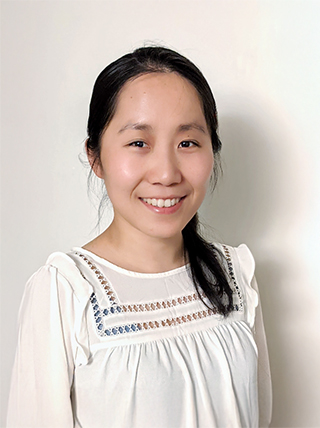
Ni Ji
2013 Ph.D. Neuroscience, Massachusetts Institute of Technology
2007 B.A. Biology and Physics, Berea College
2022-present Assistant Investigator, Chinese Institute for Brain Research, Beijing
2022.3-2022.6. Senior Postdoctoral Associate, Boston University
2016-2022 Postdoctoral fellow & Senior Scientist, Massachusetts Institute of Technology
2013-2015 Postdoctoral associate, Harvard University
Animals and humans have the remarkable ability to actively seek out new information (exploration) and rapidly derive structured knowledge from experiences (active learning), which allows them to navigate complex environments, optimize resource use, and adapt to dynamic, uncertain situations. In contrast, despite rapid advances, today’s AI agents still rely on large amounts of labeled data and struggle with autonomously learning from experience. By incorporating brain-like mechanisms for exploration and active learning, AI agents may become more data-efficient and capable of faster generalization and adaptation in unfamiliar environments.
Our group thus aim to understand how the brain explores and acquires structured knowledge in both physical and cognitive environments, particularly under uncertain or novel contexts. We focus on uncovering behavioral and neural mechanisms that control intrinsic motivation or curiosity-driven behavior, and how these principles can be translated into AI systems capable of efficient learning with minimal data. Through both empirical studies and the development of biologically plausible computational models, we seek to uncover neuro-behavioral mechanisms that enable adaptive, data-efficient exploration and learning in the brain, with the ultimate goal of creating AI algorithms that mimic these capabilities in real-world applications.
2020 Women in Science Travel (WIST) Fund
2020 Computational and Systems Neuroscience (COSYNE) Meeting Travel Award
2017-2019 Charles A. King Trust Postdoctoral Fellowship
2016-2017 JFDP Postdoctoral Fellowship
2015 Marine Biological Laboratory Computational Image Analysis Course Travel Award
2007-2011 Singleton Fellowship
2010 Okinawa Institute of Science and Technology Travel Award
2007-2009 Berea College Graduate Study Grant
2003-2007 Berea College Full Scholarship
Preprints:
1. Li, S., Li, Z., Liu, T., Zhang, S., Jia, Y., Yi, Z., Xie, J., Ji, N.# Multi-feature Riemannian hypergraph for online test-time adaptation of motor imagery brain-computer interface. 2026. arXiv preprint, arXiv:2608.16134.
2. An, J.*, Hu, J.*, Wu, Y. E.*, Liu, C., Ning, S., Zhu, F., Pan, Y., Wang, R., Ji, N.# Task-space dimensions guide human exploration in complex environments. 2026. bioRxiv preprint, 2026.04.29.720265.
Publications:
3. Jia, Z.*, Pan, Y.*, Ji, N.# Neural Structural Reasoner: A brain-inspired architecture for reasoning over structured knowledge. 2026. In Advances in Neural Information Processing Systems (NeurIPS 2026). PDF
4. Zhu, F., An, J., Ji, N.# Human-inspired, Task-Dimension-Guided Exploration for Efficient Learning in High Dimensions. 2026. In Advances in Neural Information Processing Systems (NeurIPS 2026). PDF
5. Jiang, C., An, J., Liu, Y., Ji, N.# Brain Bandit: A biologically grounded neural network for efficient control of exploration. 2025. In International Conference on Learning Representations (ICLR 2025, Oral presentation, top 1%).
Before 2022:
6. Ji, N., Madan, G.K., Fabre, G.I., Dayan, A., Baker, C.M., Kramer, T.S., Nwabudike, I, Flavell, S.W.# A neural circuit for flexible control of persistent behavior states. eLife; 2021, 10:e62889.
7. Ji, N., Venkatachalam, V., Rodgers, H. D., Lim, M., Kawano, T., Clark, C. M., Alkema, M. J.#, Zhen, M.#, Samuel, A. D. T.# Corollary discharge promotes a sustained motor state in a neural circuit for navigation. eLife, 2021, 10, e68848.
8. Ji, N., Flavell, S. W.# Hydra: Imaging nerve nets in action. Current Biology, 27(8), 2017, R294–R295.
9. Venkatachalam, V.*, Ji, N.*, Wang, X., Mitchell, J., Klein, M., Tabone, C., Clark, C. M., Greenwood, J. S. F., Chisholm, A., Srinivasan, J., Alkema, M. J., Zhen, M., Samuel, A. D. T.# Pan-neuronal imaging in roaming animals. Proceedings of the National Academy of Sciences, 2016, 113(8), E1082–E1088.
10. Ji, N.*, Middelkoop, T. C.*, Mentink, R. A., Betist, M. C., Tonegawa, S., Mooijman, D., Korswagen, H. C.#, van Oudenaarden, A.# Feedback control of gene expression variability in the Caenorhabditis elegans Wnt pathway. Cell, 2013 155(4), 869–880.
11. Tan, R. Z., Ji, N., Mentink, R., Korswagen, H. C., van Oudenaarden, A.# Deconvolving the roles of Wnt ligands and receptors in sensing and amplification. Molecular Systems Biology, 2013, 9, 631.
12. Ji, N., van Oudenaarden, A.# Single-molecule fluorescent in situ hybridization (smFISH) of C. elegans worms and embryos. WormBook. The C. elegans Research Community, 2012, doi:10.1895/wormbook.1.153.1.
13. Scott, B. B., Gardner, T., Ji, N., Fee, M. S., Lois, C.# Wandering neuronal migration in the postnatal vertebrate forebrain. Journal of Neuroscience, 2012, 32, 1436–1446.
* Equal contribution; # Corresponding author