

Wei Xiong
1999 B.Sc. in Biology, School of Life Sciences, Wuhan University – Wuhan, China
2006 Ph.D. in Neuroscience, Institute of Neuroscience, Chinese Academy of Sciences – Shanghai, China
2022-present Principal Investigator, Chinese Institute for Brain Research, Beijing
2016-2022 Principal Investigator, IDG/McGovern Institute for Brain Research at Tsinghua University
2015-2022 Principal Investigator, School of Life Sciences, Tsinghua University
2007-2015 Postdoctoral Fellow with Ulrich Müller, Department of Molecular and Cellular Neuroscience, The Scripps Research Institute
2006-2007 Research Assistant with Zhuan Zhou, Institute of Molecular Medicine, Peking University
2000-2006 Graduate student with Zhuan Zhou, Institute of Neuroscience, Chinese Academy of Sciences
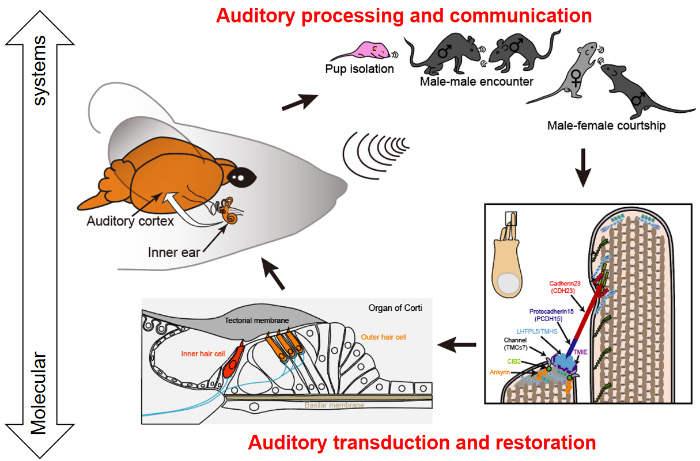
Human patients with hearing impairment have difficulty in perceiving alerts, appreciating music and especially language-based conversation. This problem exists not only in deaf patients but also those with mental illness. Our research anticipates gaining a deeper understanding of the fundamental biological principles underlying auditory perception and pathological mechanisms of the normal and diseased hearing, which would thus accelerate the development of therapeutic approaches for preventing and treating deafness and hearing problems.
The laboratory is currently focusing on (1) Identification of novel deafness genes and characterization of the gene function; (2) Molecular and neural mechanisms for sound processing, and (3) Potential therapeutic strategies on hearing impairment related with genetic mutations, noise, and ageing.
To achieve these goals, we recruit a variety of approaches and technologies: (1) Generating mouse models genetically and physiologically mimicking human patients with auditory deficiencies; (2) Developing finest in vitro, ex vivo, and in vivo neurophysiological approaches. These newly-established resources will be foundations to explore the mechanisms of auditory transduction and processing in the cochlea and the ascending brain stations, which is a long-term goal in the laboratory.
2017 The State Natural Science Award of Department of Education, China
2015 Excellent Young Scholar of National Science Foundation of China
2014 The Young Talent 1000 Program of China
2013 Dorris Neuroscience Scholar
2008 Fellowship from the Bruce Ford and Anne Smith Bundy Foundation
2004 Travel Grant from International Brain Research Organization (IBRO)
A) Research Articles
1. Liu, L.#, Zou, L.#, Li, K.#, Hou, H., Hu, Q., Liu, S., Li, J., Song, C., Chen, J., Wang, S., Wang, Y., Li, C., Du, H., Li, J. L., Chen, F., Xu, Z., Sun, W., Sun, Q., and Xiong, W.* (2022) Template-independent genome editing in the Pcdh15(av-3j) mouse, a model of human DFNB23 nonsyndromic deafness. Cell Rep 40, 111061
2. Li, J.#, Liu, S.#, Song, C.#, Zhu, T., Zhao, Z., Sun, W., Wang, Y.*, Song, L.*, and Xiong, W.* (2022) Prestin-Mediated Frequency Selectivity Does not Cover Ultrahigh Frequencies in Mice. Neuroscience Bulletin 38, 17
3. Yan, Y.#, Tian, M.#, Li, M., Zhou, G., Chen, Q., Xu, M., Hu, Y., Luo, W., Guo, X., Zhang, C., Xie, H., Wu, Q. F., Xiong, W.*, Liu, S.*, and Guan, J. S.* (2022) ASH1L haploinsufficiency results in autistic-like phenotypes in mice and links Eph receptor gene to autism spectrum disorder. Neuron 6273 (21) 01090-4.
4. Zhang, Y.#, Lin, G.#, Wang, Y.#*, Xue, N., Lin, X., Du, T.*, Xiong, W.*, and Song, L.* (2021) Prestin derived OHC surface area reduction underlies age-related rescaling of frequency place coding. Hearing Research 108406.
5. Song, C.#, Li, J.#, Liu, S., Hou, H., Zhu, T., Chen, J., Liu, L., Jia, Y., and Xiong, W. (2021) An L1 retrotransposon insertion induced deafness mouse model for studying the development and function of the cochlear stria vascularis. Proc Natl Acad Sci U S A 118 (40) e2107933118.
6. Li, J.#, Liu, S.#, Song, C.#, Hu, Q.#, Zhao, Z.#, Deng, T., Wang, Y., Zhu, T., Zou, L., Wang, S., Chen, J., Liu, L., Hou, H., Yuan, K., Zheng, H., Liu, Z., Chen, X., Sun, W., Xiao, B., and Xiong, W. (2021) PIEZO2 mediates ultrasonic hearing via cochlear outer hair cells in mice. Proc Natl Acad Sci U S A 118 (28) e2101207118.
7. Du, H.#, Zou, L.#, Ren, R., Li, N., Li, J., Wang, Y., Sun, J., Yang, J., Xiong, W.*, and Xu, Z.* (2020). Lack of PDZD7 long isoform disrupts ankle-link complex and causes hearing loss in mice. FASEB J 34, 1136-1149.
8. Wang, Y., Su, F., Wang, S., Yang, C., Tian, Y., Yuan, P., Liu, X., Xiong, W.*, and Zhang, C.* (2019) Efficient implementation of convolutional neural networks in the data processing of two-photon in vivo imaging. Bioinformatics 35, 3208-3210.
9. Liu, S., Wang, S., Zou, L., Li, J., Song, C., Chen, J., Hu, Q., Liu, L., Huang, P., and Xiong, W. (2019). TMC1 is an essential component of a leak channel that modulates tonotopy and excitability of auditory hair cells in mice. Elife 8, e47441.
10. Hu, Q., Guo, L., Li, J., Song, C., Yu, L.*, He, D.Z.Z.*, and Xiong, W.* (2018). Deletion of Kncn Does Not Affect Kinocilium and Stereocilia Bundle Morphogenesis and Mechanotransduction in Cochlear Hair Cells. Front Mol Neurosci 11, 326.
11. Chen, J., Zhang, X., Li, J., Song, C., Jia, Y.*, and Xiong, W.* (2016). Identification of a Novel ENU-Induced Mutation in Mouse Tbx1 Linked to Human DiGeorge Syndrome. Neural Plast 2016, 5836143.
12. Xiong, W.*, Wagner, T., Yan, L., Grillet, N., and Mller, U.* (2014) Using injectoporation to deliver genes to mechanosensory hair cells. Nat Protoc 9, no. 10: 2438-49.
B) Books and Reviews
1. Liu, S., Wang, S., Zou, L., and Xiong, W. (2021) Mechanisms in cochlear hair cell mechano-electrical transduction for acquisition of sound frequency and intensity. Cell Mol Life Sci 78, 5083-5094 (Review).
2. Xiong, W.* and Xu, Z.* (2018) Mechanotransduction of the Hair Cell. Springer Singapore (Book)