

Zaixu Cui
2007.09-2011.07 B.S. Department of Computer Science and Technology, Anhui University, China
2011.09-2017.07 Ph.D. State Key Laboratory of Cognitive Neuroscience and Learning, Beijing Normal University, China
04/2021-Present Chinese Institute for Brain Research, Beijing, China Assistant Investigator
10/2017-03/2021 Department of Psychiatry, University of Pennsylvania, USA Postdoctoral Fellow
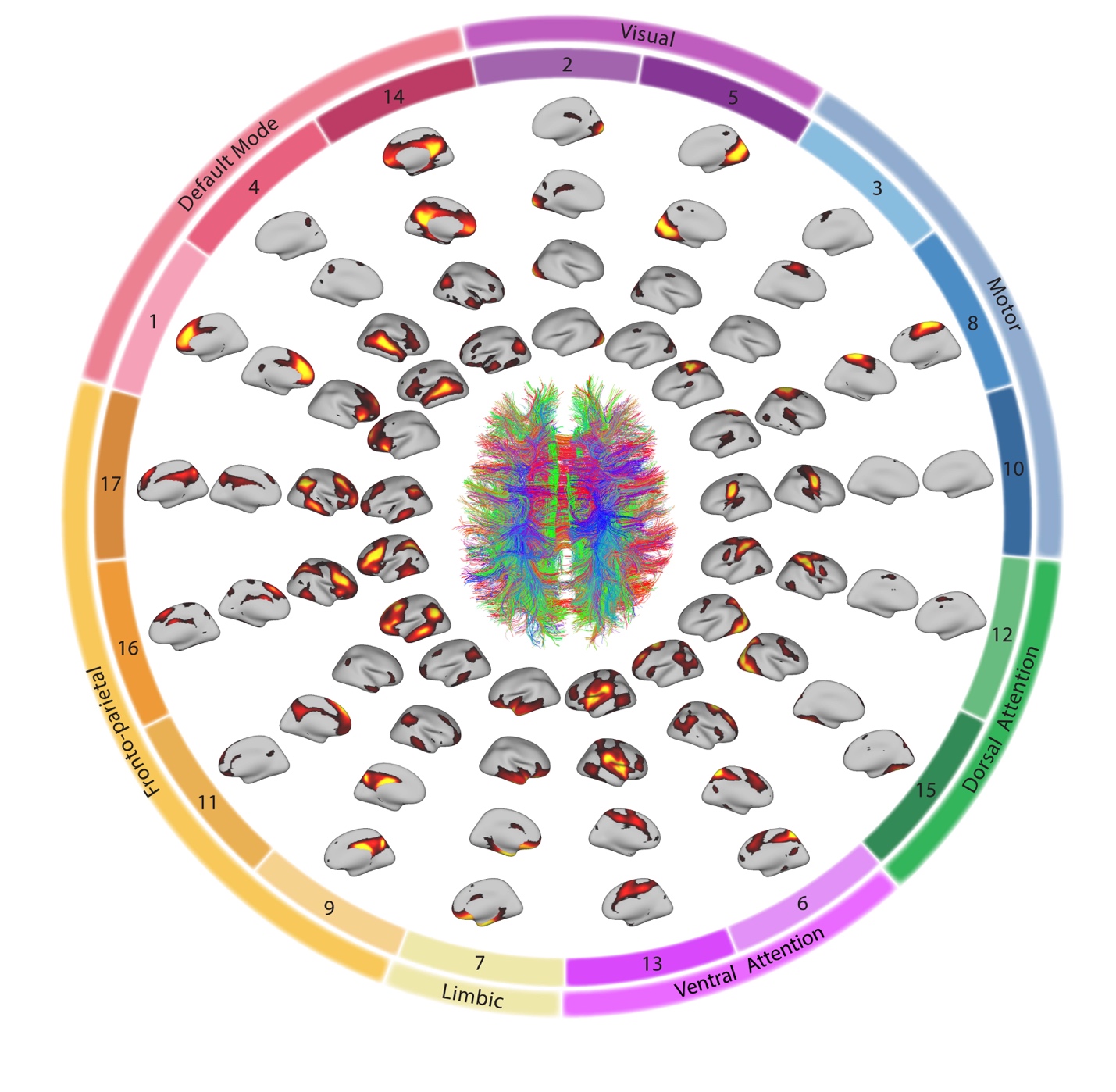
Human behaviors arise from a complex network of billions of neurons connected by trillions of synapses. The goal of our lab is to understand the fundamental organizational principles and behavioral relevance of the human brain network, its development in youth, and its deficits in mental disorders. To achieve this goal, we implement behavioral and neuroimaging experiments, and use both classical and cutting-edge computational tools from machine learning and network science. The following three interrelated research topics are of our key research interests.
1. The architecture of brain networks.
Diffusion MRI allows us to tract white-matter tracts in vivo by detecting the random thermodynamic motion of water molecules in brain tissues. With this technique, it is possible to reconstruct the human connectome at a millimeter scale by modeling each brain region as a network node and white-matter pathways as network edges. Using functional MRI, we construct the functional networks by modeling the edges as the correlation between the time series of two brain regions. Both human structural and functional networks present a complex topology, such as small-world architecture, rich-club, modularity, and a cost-efficiency balance. We seek to fully describe the organization principles of both human structural and functional networks using tools from graph theory and algebraic topology.
2. The functional and cognitive implications of the structural connectome.
The network topology of structural connectome supports the communication dynamics between neuronal elements, which underlies all aspects of brain function and human cognitions. We are interested in building a generative model of how the functional dynamics during the execution of a cognitive task emerge from the underlying structural connectome. We construct the structural connectome using the fiber tractography on the data from diffusion MRI. To link connectome and cognition, we employ computational tools from network control theory and implement experimental manipulation with both whole-brain non-invasive neuroimaging (i.e., fMRI and MEG) and local invasive recordings (i.e., iEEG).
3. The network mechanism underlying both normal and abnormal development of executive function in health and mental disorders.
Executive function refers to a broad category of cognition, including working memory, mental flexibility, sustained attention and inhibition. Executive function undergoes dramatic development during childhood and adolescence, while failures of executive function are associated with risk-taking behaviors and a wide range of mental disorders. We examine how the development of personalized functional and structural networks supports the executive function, and how its abnormal development associates with executive deficits in mental disorders. We are particularly interested in the transdiagnostic features cutting across different mental disorders.
We welcome applications from students and postdoctoral fellows with backgrounds in cognitive neuroscience, theoretical/biological physics, network science, complex systems, computer science, applied mathematics, bioengineering, or psychology.
1. Cui Z, Pines AR, Larsen B, Sydnor VJ, Li H, Adebimpe A, Alexander-Bloch AF, Bassett DS, Bertolero M, Calkins ME, Davatzikos C, Fair DA, Gur RC, Gur RE, Moore TM, Shanmugan S, Russell TS, Jacob WV, Cedric HX, Yong F, Satterthwaite TD (2022). Linking Individual Differences in Personalized Functional Network Topography to Psychopathology in Youth. Biological Psychiatry.
2. Chen R*, Cui Z*, Capitao L, Wang G, Satterthwaite TD, Harmer CJ. Precision biomarkers for mood disorders based on brain imaging. (2020) BMJ. 371:m3618.
3. Cui Z, Li H, Xia CH, Larsen B, Adebimpe A, Baum GL, Cieslak M, Gur RE, Gur RC, Moore TM, Oathes DJ, Alexander-Bloch A, Raznahan A, Roalf DR, Shinohara RT, Wolf DH, Davatzikos C, Bassett DS, Fair DA, Fan Y, Satterthwaite TD. Individual variation in functional topography of association networks in youth. (2020) Neuron. 106(2): 340-53.
4. Cui Z, Stiso J, Baum GL, Kim JZ, Roalf DR, Betzel RF, Gu S, Lu Z, Xia CH, He X, Ciric R, Oathes DJ, Moore TM, Shinohara RT, Ruparel K, Davatzikos C, Pasqualetti F, Gur RE, Gur RC, Bassett DS, Satterthwaite TD. Optimization of energy state transition trajectory supports the development of executive function during youth. (2020) eLife. 9:e53060.
5. Cui Z, Gong G. The effect of machine learning regression algorithms and sample size on individualized behavioral prediction with functional connectivity features. (2018) NeuroImage, 178: 622-37.
6. Cui Z*, Su M*, Li L, Shu H, Gong G. Individualized prediction for reading comprehension abilities using gray matter volume. (2018) Cerebral Cortex, 28(5): 1656-72.
7. Cui Z*, Xia Z*, Su M, Shu H, Gong G. Disrupted white matter connectivity underlying developmental dyslexia: a machine learning approach. (2016) Human Brain Mapping, 37(4):1443-58.
8. Cui Z, Zhong S, Xu P, He Y, Gong G. PANDA: a pipeline toolbox for analyzing brain diffusion images. (2013) Frontiers in Human Neuroscience, 7:42. doi: 10.3389/fnhum.2013.00042.