Cell|Sub-second dopamine reinforcement shapes juvenile social play|Ying Li & Ni Ji Lab
Summary
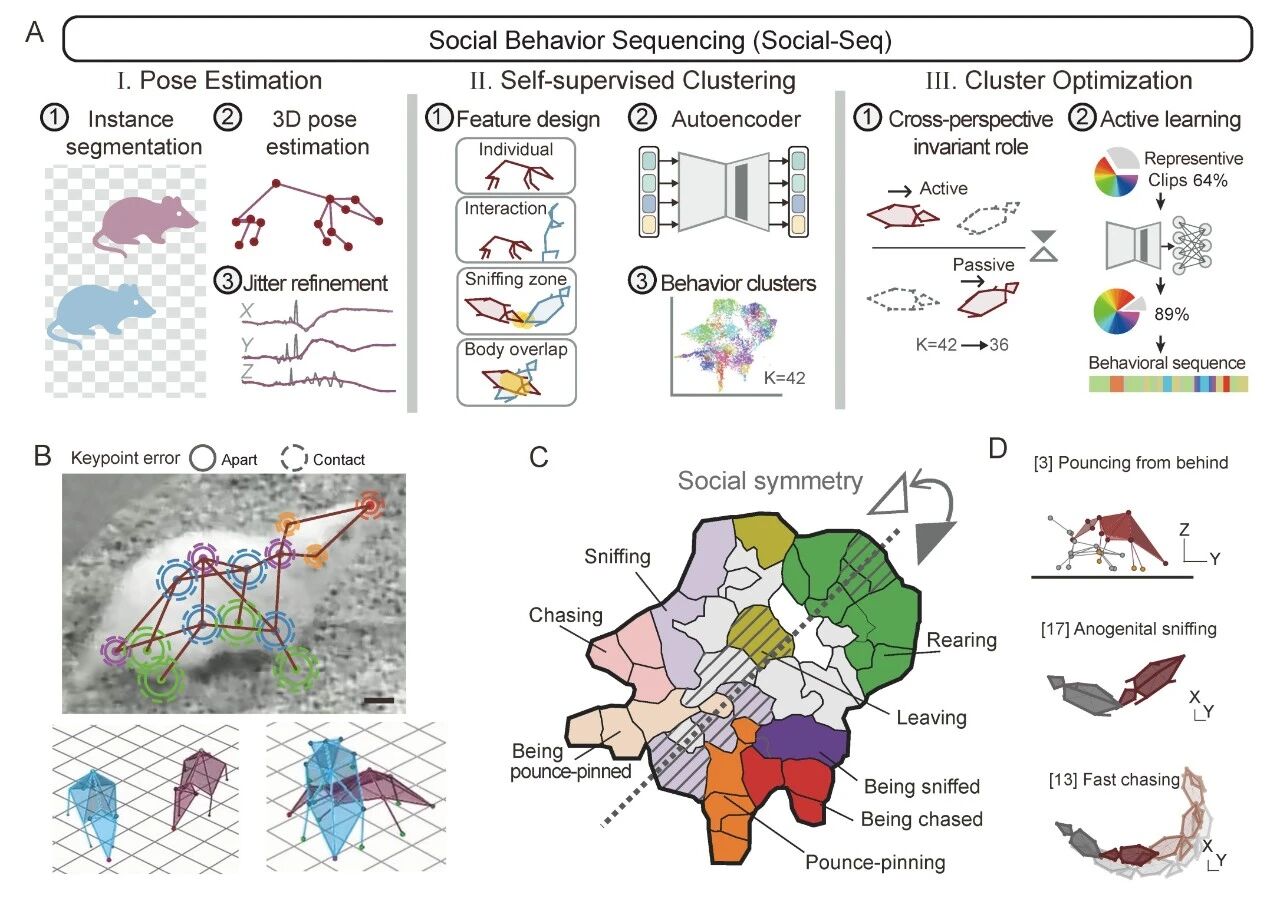
Juvenile social play is critical for neurodevelopment, yet the neural mechanisms organizing moment-to-moment interactions remain elusive. Using social behavior sequencing (Social-seq)—an occlusion-robust 3D pose estimation and unsupervised clustering pipeline—we found that nucleus accumbens (NAc) dopamine was tightly coupled to sub-second social syllables during naturalistic interactions. In wild-type juveniles, males exhibited a sharper dopaminergic contrast between proactive play and forced submission than females did, consistent with sex-divergent play strategies. In Shank3-deficient autism models, this process was fundamentally corrupted: proactive play-evoked dopamine responses were abolished in males and significantly sign-inverted in females, with male-specific enhancements during non-social behaviors, driving social play deficits. A multi-agent reinforcement learning model parameterized by disrupted, play-related dopaminergic reinforcement values recapitulated mutant phenotypes. Closed-loop optogenetic stimulation of ventral tegmental area (VTA)-NAc dopamine projections, time-locked to proactive play, restored reciprocal play in Shank3-deficient rats. Sub-second dopaminergic reinforcement thus orchestrates naturalistic social behavior, providing a behaviorally contingent interventional framework for neurodevelopmental disorders.
Link: https://www.cell.com/cell/fulltext/S0092-8674(26)01327-9